 (702) 333-8057
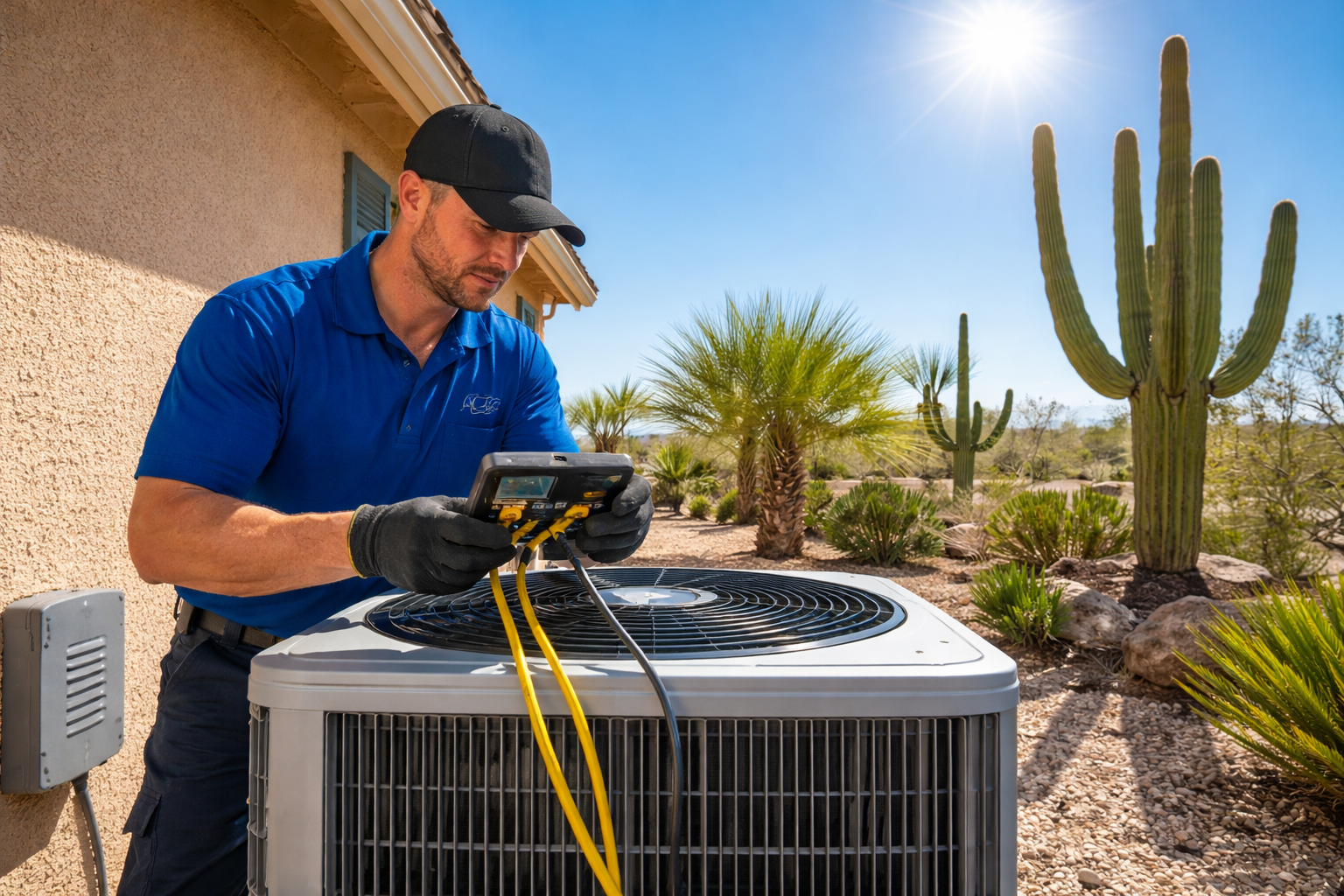
Why AC Systems Fail Faster in Las Vegas Heat — And How to Prevent It
- Why Las Vegas AC Fails Faster
- 300+ Days Sun
- 115°F Peak Temps
- Desert Dust Factor
- (702) 333-8057
Las Vegas is one of the most demanding HVAC environments in North America. The combination of extreme peak temperatures, a cooling season that runs six months or longer, and airborne desert dust creates conditions that accelerate equipment wear in ways that most homeowners — and even some contractors from other markets — don't fully account for. If your AC seems to need repairs more often than it should, or fails earlier than the manufacturer's rated lifespan, the climate is the most likely explanation. Here's exactly what's happening inside your equipment — and what you can do to slow it down.
The Las Vegas Climate Is Exceptional — And So Is Its Toll on AC Equipment
Most residential AC systems are rated and tested under standard conditions — typically around 95°F outdoor temperatures. Las Vegas regularly exceeds that by 20 degrees. When outdoor temps hit 115°F, your condenser is trying to reject heat into ambient air that is already extremely hot. This forces the compressor to work significantly harder and for much longer, generating more internal heat and mechanical stress with every cycle.
The duration of the Las Vegas cooling season compounds the problem. A homeowner in, say, Charlotte or Denver might run their AC 3–4 hours a day during a 3–4 month season. In Las Vegas, that same system runs 8–10 hours daily from late April through October — roughly 1,500–1,800 hours of annual runtime versus 500–700 hours in a more moderate climate. That's more than twice the accumulated mechanical wear per year. On a 10-year system, a Las Vegas AC has effectively experienced the operational equivalent of 20+ years of use compared to a system in a milder market.
Then there's the desert itself. The Las Vegas valley is surrounded by open desert that generates fine grit and dust constantly. Unlike humid climates where airborne particles tend to settle quickly, the dry desert air keeps particulates suspended longer. Condenser coils — the large finned sections on your outdoor unit — act like filters for this airborne grit. Over months, a clogged condenser coil can lose 10–30% of its heat rejection efficiency, forcing everything upstream — compressor, refrigerant circuit, electrical components — to compensate by working harder.
Why Specific Components Fail Faster in Las Vegas
Capacitors
Capacitors store and release the electrical charge that starts and runs the compressor and fan motors. The dielectric fluid inside degrades faster at high temperatures — exponentially so above 100°F. A run capacitor that might last a decade in a moderate climate can fail in 5–6 years under sustained Las Vegas heat. Bulging or leaking capacitors are one of the most common calls ACE Las Vegas receives from June through August.
Compressor
The compressor is the heart of the refrigeration system — and the most expensive component to replace. Compressor lubricating oil breaks down faster under sustained high operating temperatures, accelerating internal wear on pistons and bearings. Repeated thermal cycling — the expansion and contraction of metal as the compressor heats up and cools down — also creates micro-stress fractures in seals and connections over time.
Condenser Coil
Desert dust and grit pack into condenser coil fins and restrict airflow, reducing the system's ability to shed heat into the outdoor air. A 20–30% reduction in heat rejection efficiency doesn't just mean reduced cooling — it forces the compressor to run at higher pressures, raising operating temperatures throughout the system and accelerating wear on every component simultaneously.
Contactor
The contactor is the high-voltage relay switch that sends power to the compressor when the thermostat calls for cooling. In Las Vegas, the contactor switches on and off dozens of times per day during summer — far more frequently than in moderate climates. The arcing that occurs during switching pits the contactor points over time, and the high ambient heat accelerates the coil degradation that eventually causes failure.
Refrigerant Lines
The copper refrigerant lines running between your indoor air handler and outdoor condenser expand and contract with temperature changes. In Las Vegas, those temperature swings are extreme — from 115°F in the afternoon to the 80s overnight. Over years, this thermal cycling can cause micro-cracks at fittings and brazed joints, leading to slow refrigerant leaks that gradually reduce system efficiency before they become obvious.
The Preventive Maintenance Actions That Actually Matter
Not all maintenance is equal. These are the specific tasks that address the failure mechanisms most relevant to Las Vegas conditions, ranked by impact:
| Maintenance Task | How Often | What It Prevents |
|---|---|---|
| Air filter replacement | Monthly during peak season (June–Sept); every 60 days in shoulder months | Restricted airflow starves the evaporator coil, causing it to ice over and eventually forcing the compressor into overload conditions. In desert climates, filters clog significantly faster than manufacturer recommendations suggest. |
| Condenser coil cleaning | Pre-season (April–May), ideally annually | Removes accumulated dust and grit that reduces heat rejection efficiency. A clean condenser can mean the difference between a system that handles 115°F days comfortably and one that trips on high-pressure lockout. |
| Electrical component inspection | Pre-season (April–May) | Identifies capacitors measuring below rated microfarads before they fail outright, contactors with pitted points, and loose connections that create resistance and heat. Catching these before June can prevent a breakdown during the hottest weeks of the year. |
| Refrigerant level check | Annually, or if cooling performance has declined | Low refrigerant forces the compressor to work harder to achieve the same cooling effect, accelerating wear and raising operating temperatures. Identifying a slow leak early prevents the compressor damage that can result from running significantly undercharged. |
| Condensate drain flush | Annually, at the start of cooling season | Algae and mineral buildup in the condensate drain line causes overflow that can damage ceilings, drywall, and flooring. A simple flush prevents an expensive and disruptive water damage claim. |
Warning Signs Your System Is Already Struggling
Las Vegas AC systems often give clear signals before they fail completely. Watch for these:
- Warm or lukewarm air coming from registers even though the system is running — indicates low refrigerant, a dirty coil, or a failing compressor
- Monthly electric bills climbing noticeably without a change in usage habits — a degraded system works harder and longer to achieve the same cooling, showing up directly on your NV Energy bill
- Frequent short cycling — the system turning on and off every few minutes rather than completing normal run cycles — often a sign of refrigerant issues, electrical faults, or an oversized system
- Grinding, buzzing, or rattling sounds from the outdoor condenser unit — the condenser fan motor, compressor mounts, or capacitor may be failing
- Ice forming on the refrigerant lines or evaporator coil — counterintuitively, ice means the system is not cooling effectively; it indicates severely restricted airflow or low refrigerant charge
- Burning smell from registers or the air handler — never ignore this; shut the system off and call for service immediately
If you're experiencing any of these, a diagnostic call from ACE Las Vegas will identify the cause before it turns into a full breakdown. Call (702) 333-8057 or visit our emergency AC repair page for same-day service options.
When to Call for Repair (and When to Consider Replacement)
Repair is usually the right call when the system is under 12 years old and the failure is isolated to a single component — a capacitor, contactor, or fan motor. These are predictable wear items that don't indicate broader system deterioration. A well-maintained system in Las Vegas can realistically reach 12–15 years, though at the lower end of that range compared to the same equipment in a milder climate.
Replacement makes more sense when the system is 12–15 years or older, when it uses R-22 refrigerant (which is both expensive and increasingly scarce), or when it has needed two or more significant repairs within an 18-month window. Multiple failures in a short period typically indicate systemic degradation — not bad luck — and putting additional repair money into the system compounds the cost without extending its useful life meaningfully. When replacement is the right answer, ACE Las Vegas offers current equipment options with 36-month 0% interest financing and 90 days zero payments to make the transition manageable.
Stop a Las Vegas AC Failure Before It Starts
Schedule a pre-season tune-up or request a same-day diagnostic. New customers: $49 tune-up special. We service all brands, all ages, 24/7.
(702) 333-8057 — Call ACE Las Vegas Book OnlineFrequently Asked Questions
How often should I change my AC filter in Las Vegas?
Monthly during the peak cooling season — June through September — and every 60 days during the shoulder months of April, May, and October. Standard 1-inch filters in Las Vegas homes clog significantly faster than the manufacturer's typical 90-day recommendation because of the constant airborne desert dust. A clogged filter is one of the leading causes of evaporator coil icing, reduced airflow, and compressor strain. If you have pets or a particularly dusty home environment, check filters every 3 weeks during summer. This is the single cheapest maintenance step you can take, and one of the most impactful.
Why does my AC run constantly in Las Vegas summers?
Constant running during a 115°F day is sometimes normal — the system is genuinely working at or near its capacity limit to overcome the heat load. However, if the system runs continuously without bringing indoor temperatures to the set point, that's a problem. Common causes include low refrigerant charge reducing cooling capacity, dirty condenser coils reducing heat rejection efficiency, an undersized system for the home's square footage, or poor attic insulation allowing heat to pour in faster than the AC can remove it. A diagnostic call will identify which factor is at play. If the system runs constantly but does reach your set temperature, consider raising the thermostat by a degree or two during peak afternoon hours — it reduces compressor strain without significantly affecting comfort.
How long should an AC system last in Las Vegas?
A well-maintained system in Las Vegas typically lasts 12–15 years. The same system in a moderate climate might reach 15–20 years. The accelerated wear comes from longer annual runtime hours, higher operating temperatures, and desert dust — all of which increase mechanical and electrical stress on every component. Systems that skip regular maintenance (particularly coil cleaning and filter changes) often fail at 8–10 years. Systems that receive annual tune-ups and address small issues proactively consistently hit or exceed the 15-year mark. If your system is approaching 12 years and has needed a significant repair, it's worth getting a replacement quote alongside any repair estimate so you can make a fully informed decision.